 Tony Bennett Swings with Count...
Tony Bennett - vocalist
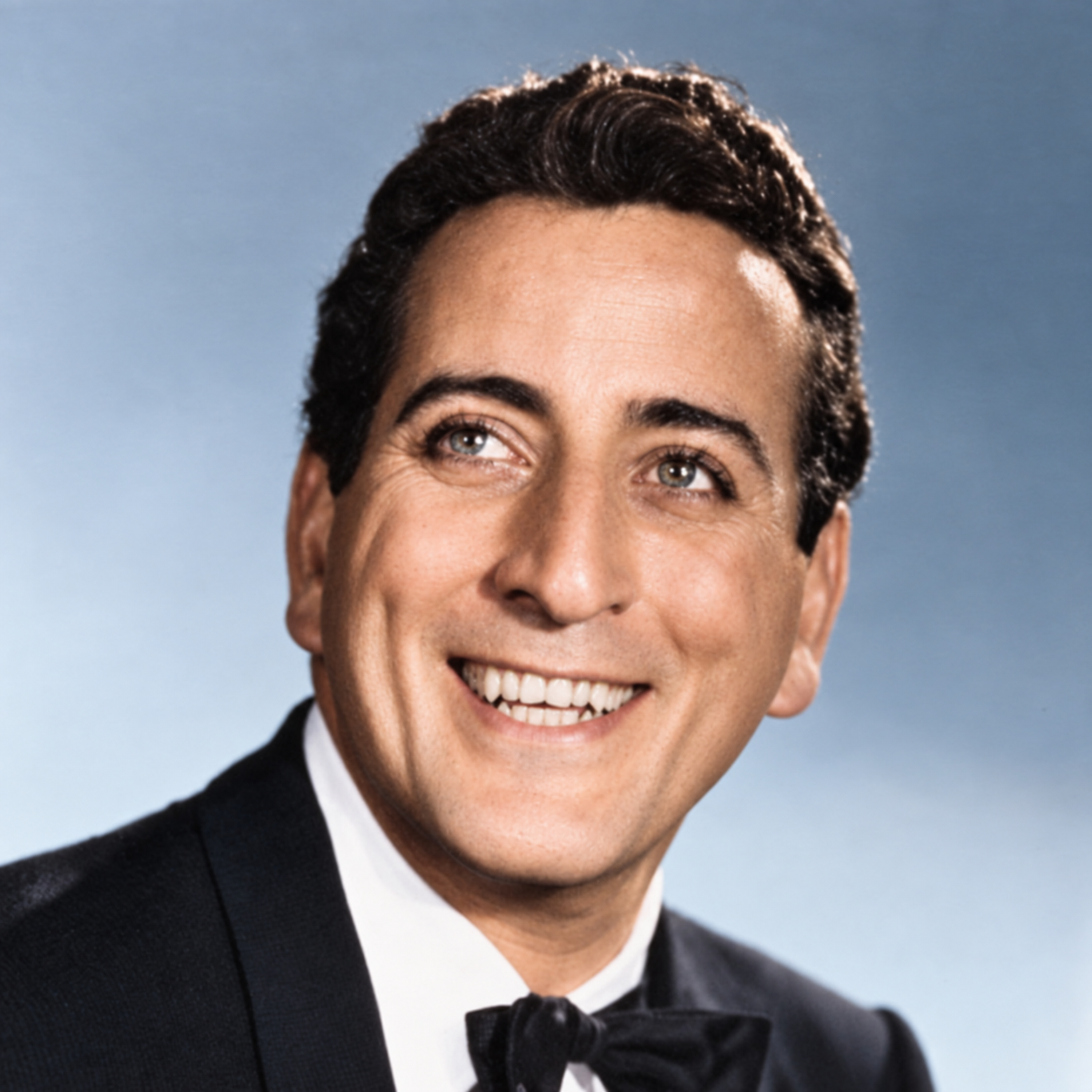
Tony Bennett (b. August 3, 1926, Astoria, NY – d. July 21, 2023, New York, NY) born Anthony Dominick Benedetto, built one of the longest and most varied careers in American popular music. Over more than seven decades he remained closely associated with the Great American Songbook, yet his career repeatedly moved through periods of commercial success, changing musical fashions, personal difficulties, artistic experimentation and renewal. He died in New York in 2023, at the age of 96.Bennett was the son of Italian immigrants. His father died when Tony was ten, during the Depression, leaving his mother Anna to raise Tony and his older brother and sister. Music and art were already important parts of his childhood. He attended the High School of Industrial Arts in Manhattan, where he developed both his interest in singing and his talent as a visual artist. At home and on the radio he heard Bing Crosby, Louis Armstrong and other singers and musicians who helped shape his musical instincts.
As a teenager, Bennett sang while working as a waiter. In 1944 he was drafted into the U.S. Army and served as an infantryman in Europe. His division fought its way through Germany in 1945 and took part in the liberation of a concentration camp. After the war he remained in Germany for a time with the occupation forces and sang with an Army Special Services band. He returned to New York in 1946 and used the GI Bill to study bel canto singing at the American Theatre Wing.
The first years after the war were not easy. Bennett worked under the stage name Joe Bari, taking whatever engagements he could find. His first nightclub appearance came in 1946, when he sat in with trombonist Tyree Glenn at the Shangri-La in Astoria. He continued working in small clubs and gradually established himself as a singer in New York.
His breakthrough came in 1949. Bennett was performing with Pearl Bailey in Greenwich Village when comedian Bob Hope heard him. Hope was sufficiently impressed to invite him to appear at the Paramount Theatre with his show. Hope also disliked the stage name Joe Bari and asked for Bennett's real name. Anthony Dominick Benedetto became Tony Bennett.
Bennett signed with Columbia Records, where producer and arranger Mitch Miller played an important role in his early career. His first major success came with “Because of You” in 1951. It was followed by a series of hits, including “Cold, Cold Heart,” “Rags to Riches” and other songs that established him as one of the leading American singers of the early 1950s. His debut album, Because of You, appeared in 1952.
The success was substantial, but Bennett's ambitions went beyond being a successful pop singer. He was deeply interested in jazz and in the musicians who had shaped American popular music. His influences included Louis Armstrong and Bing Crosby, while his approach to phrasing and interpretation was informed by jazz musicians and singers. He listened closely to instrumentalists and treated the words of a song as something to be shaped rhythmically and emotionally rather than simply delivered.
During the 1950s he gradually moved toward more jazz-oriented material. His work with pianist Ralph Sharon became particularly important. Sharon understood Bennett's ambitions and helped him develop a repertoire built around sophisticated songs by composers such as George Gershwin, Cole Porter, Rodgers and Hart, Harold Arlen and Duke Ellington.
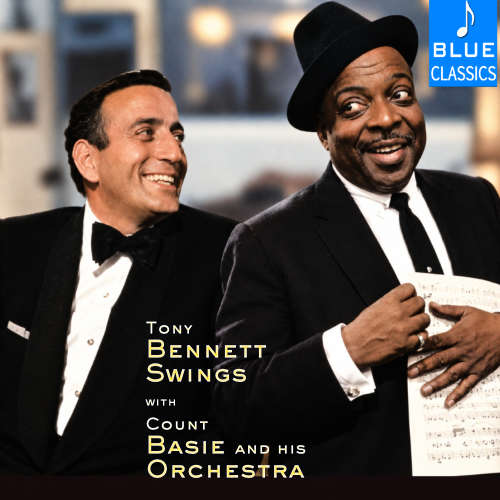
Bennett's career during this period included both large commercial recordings and collaborations with jazz musicians. He recorded with the Count Basie Orchestra, among others, and developed an increasingly close association with the jazz tradition. His recording career was not confined to the singles market; he made albums devoted to particular composers, songwriters and musical styles.
In 1962 came the recording that would become his signature: “I Left My Heart in San Francisco.” The song, written by George Cory and Douglass Cross, had originally been largely unknown. Bennett's recording transformed it into an international standard. The single remained on the charts for nine months, while the album eventually went gold. At the 1963 Grammy Awards, Bennett won Record of the Year and Best Solo Vocal Performance, Male for the song.
The success placed Bennett at the centre of American popular music. From 1962 through 1966 he released 15 albums and remained a prominent television performer. He continued recording a mixture of contemporary songs and standards and maintained an exceptionally demanding touring schedule. Frank Sinatra, one of Bennett's most important artistic allies, publicly praised him during this period, calling him a singer who could communicate what a composer intended "and probably a little more."
Bennett's relationship with jazz and with American musical culture also had a political dimension. He was an active supporter of civil rights and participated in the 1965 Selma-to-Montgomery march with Martin Luther King Jr. He had also quietly challenged segregation in the entertainment business, including by helping Black musicians appear in venues where they might otherwise have been excluded.
The middle and late 1960s, however, brought a major change in the musical landscape. Rock became increasingly dominant, and the sophisticated vocal-pop tradition associated with Bennett, Sinatra and their generation was increasingly regarded as old-fashioned. Bennett continued to have successes, including “The Good Life,” “I Wanna Be Around,” “Who Can I Turn To” and “The Shadow of Your Smile,” but the market around him was changing rapidly.
The early 1970s marked the beginning of a prolonged difficult period. Bennett disliked the direction in which popular music was moving and resisted changing his musical identity to follow contemporary trends. His relationship with Columbia deteriorated, and in 1972 he left the label after more than 15 years. He briefly recorded for MGM and subsequently founded his own label, Improv Records, giving himself greater artistic control.
Artistically, the Improv period was one of the most interesting chapters of Bennett's career. Commercially, however, it was unsuccessful. He recorded albums with the Ruby Braff–George Barnes Quartet, worked with the pianist Bill Evans and made collections devoted to Rodgers and Hart and other repertoire. The label lasted only about two years and released only a small catalogue. Yet the recordings have subsequently come to be regarded as some of the most accomplished work of his career.
The collaboration with Bill Evans was particularly important. Their first album together was recorded in 1975 at Fantasy Studios in Berkeley. There was no rhythm section: only Bennett and Evans, with producer Helen Keane and engineer Don Cody present. The two musicians selected the songs and worked out the arrangements together, largely on the spot. The Tony Bennett/Bill Evans Album was followed in 1976 by Together Again. Neither was a major commercial success at the time, but both recordings revealed Bennett as an exceptionally sensitive jazz singer, capable of working with an unusually subtle and harmonically sophisticated pianist.
The artistic quality of this period contrasts sharply with Bennett's personal and professional difficulties. By the late 1970s he was without a major recording contract and had become increasingly dependent on Las Vegas engagements. His second marriage was breaking down, his finances were in serious trouble, and he had developed a dependency on drugs, including cocaine. His own accounts describe the period as one of the darkest in his life. In 1979, after becoming heavily intoxicated on cocaine and marijuana, he nearly died after passing out in a bathtub. His wife, Sandra Grant, found him and helped save his life.
The financial situation was also severe. The IRS was attempting to recover approximately $2 million in unpaid taxes, and Bennett had lost much of the professional infrastructure that had supported him earlier in his career. His record label had failed, his bookings outside Las Vegas had diminished, and he was increasingly regarded as an artist from a previous era.
The turning point came when Bennett asked his sons Danny and Dae for help. Danny, who had experience in the music business, eventually became his manager. Rather than trying to transform Bennett into a contemporary pop singer, Danny took the opposite approach. He moved his father back to New York, reduced the emphasis on Las Vegas, rebuilt his touring career through colleges and smaller theatres, and reunited him with Ralph Sharon. The strategy was to present Bennett not as an old-fashioned entertainer but as a serious singer and interpreter.
In 1986 Bennett returned to Columbia Records with The Art of Excellence. It was his first album to chart in 14 years. The record marked the beginning of one of the most remarkable second acts in modern popular music.
During the late 1980s and early 1990s, Bennett began reaching younger audiences without changing his fundamental musical approach. He appeared on late-night television and increasingly in settings outside the traditional supper-club circuit. His albums Perfectly Frank and Steppin' Out, devoted respectively to Frank Sinatra and Fred Astaire-related repertoire, won Grammy Awards. He also became increasingly visible on television and in films, while his old recordings found new audiences.
Then came MTV Unplugged in 1994. Bennett was 68 years old, an age at which the music industry rarely offered performers a major new audience. The television appearance placed him in a setting usually associated with younger rock and pop artists. He appeared with the Ralph Sharon Trio and guests including Elvis Costello and k.d. lang. The resulting album won the 1995 Grammy Award for Album of the Year.
The success of MTV Unplugged did not require Bennett to modernize his music. Instead, it demonstrated that the songs themselves, his phrasing and his personality could connect with listeners who had grown up with entirely different musical styles.
The 1990s therefore became another period of renewal. Bennett recorded tribute albums to Frank Sinatra, Fred Astaire, Billie Holiday and Duke Ellington and continued working with musicians from several generations. He also appeared at unusual venues for a singer associated with the American Songbook, including the Glastonbury Festival in 1998.
Bennett's visual art remained an equally important part of his life. He had painted since childhood, and his artwork was exhibited and collected under his family name, Benedetto. His paintings entered institutional collections, including the Smithsonian, while he continued to work as an artist throughout his career.
In 1999, Bennett and his wife Susan founded Exploring the Arts, an organisation dedicated to strengthening arts education in public high schools. His artistic and humanitarian work increasingly became intertwined. He supported civil-rights initiatives, educational programmes, medical research and other causes throughout his later life.
The new century brought another extraordinary phase. Bennett remained a recording artist long after most of his generation had retired. His collaborations with younger singers and musicians became an important part of his later career, but he continued to base his work on the repertoire he had explored throughout his life.
In 2011, Duets II brought Bennett together with artists including Lady Gaga, Amy Winehouse, John Mayer, Norah Jones and others. The album reached No. 1 on the Billboard 200, making Bennett, at 85, the oldest living artist to reach the top of that chart at that time.
His relationship with Lady Gaga developed into a sustained musical partnership. In 2014 they released Cheek to Cheek, an album of jazz standards that again reached No. 1 on the Billboard 200. Bennett was 88. The album won the Grammy for Best Traditional Pop Vocal Album. The following year, his collaboration with pianist Bill Charlap, The Silver Lining: The Songs of Jerome Kern, won the same Grammy category.
By his 90th birthday in 2016, Bennett had become both a performer and a living connection to an earlier musical culture. NBC celebrated his 90th birthday with a major television special featuring Lady Gaga, Stevie Wonder, Billy Joel, Bob Dylan and other artists.
His career had therefore come full circle. The young singer from Queens who had learned from Crosby and Armstrong had become the senior figure to whom younger singers looked for lessons in phrasing, repertoire and stagecraft. He had survived the transition from swing to rock, the decline of traditional pop, the fragmentation of the record business and the collapse and rebuilding of his own career.
Bennett continued performing into his 90s, although his health eventually made touring increasingly difficult. In 2021 his family disclosed that he had Alzheimer's disease. He nevertheless continued making music for a time, including his final recordings with Lady Gaga. His last public performances took place in 2021. ([The Washington Post][10])
Tony Bennett died on July 21, 2023, at his home in New York, just weeks before his 97th birthday.
His career is unusual not simply because of its length, but because it contains several distinct lives within one career. There was the young postwar singer who became a recording star in the early 1950s; the sophisticated jazz-influenced vocalist of the 1950s and 1960s; the artist who refused to abandon the American Songbook when rock changed the market; the experimental musician who recorded with Bill Evans during his commercially difficult years; the singer who nearly lost his career and his life in the late 1970s; and finally the artist who rebuilt his reputation without abandoning his musical principles.
The difficult periods are an essential part of that story. Bennett's career did not proceed in a straight line from success to success. He experienced periods when his records stopped selling, when his label failed, when his work was considered outdated, when he was deeply in debt, and when drugs and personal problems nearly destroyed him. His eventual resurgence was not based on changing his artistic identity. Instead, it came from returning to the music that had always mattered to him, rebuilding his audience gradually, and presenting the Great American Songbook as living music rather than nostalgia.
That consistency became the defining characteristic of Tony Bennett's career. He spent more than seventy years interpreting songs written by other people, yet his individual approach to rhythm, diction, phrasing and emotional restraint made many of those performances unmistakably his own. His recordings became a bridge between the swing era, postwar popular music, the jazz tradition and later generations of singers.
Tony Bennett remained, above all, a singer who believed that a good song could survive changes in fashion. His career demonstrated that belief repeatedly—from his first Columbia hits in the early 1950s to I Left My Heart in San Francisco, the difficult years of the 1970s, his return to Columbia in the 1980s, MTV Unplugged in the 1990s, and his late recordings with artists born generations after him. His final years did not erase the periods of uncertainty and failure that preceded them. Instead, they completed a career in which setbacks, artistic independence and renewal were as important as commercial success.